

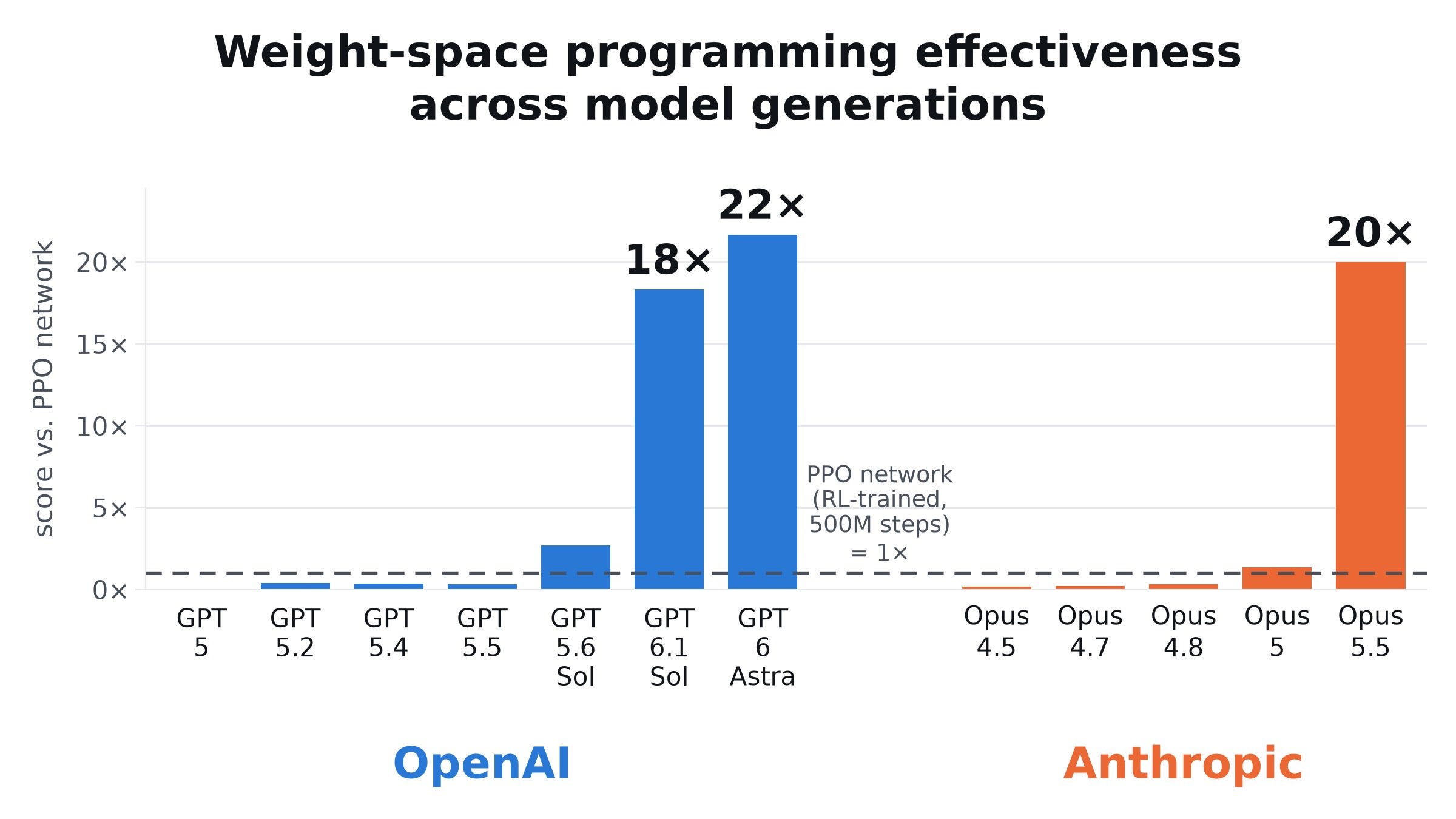
Researchers showed that GPT-6 Astra can read, understand and directly modify the weights of other neural networks. This is a significant development in AI research.
The conventional approach to improving models involves repeatedly testing a model, measuring its errors and adjusting its internal parameters.
MIT CSAIL researchers showed a new approach. An AI model can reason about another neural network’s internal structure and directly change the parameters that control its behavior.
Advanced AI models can improve smaller models.
A neural network is a collection of calculations controlled by values called weights. These weights determine how the network responds to different inputs.
Traditional training adjusts these dials through repeated calculations over data. Astra can examine them and make changes directly. Other researchers have replicated this approach using additional advanced models.
The researchers call this Weight-Space Programming.
These are smaller models being enhanced. The more interesting question is whether the same approach works on significantly larger language models.
6X improvements with 0.016% changes to weights.
The researchers gave Astra access to Qwen3.5-0.8B, an open-weight language model with approximately 800 million parameters.
Astra discovered that the model frequently became stuck repeating its reasoning, generating thousands of tokens without reaching an answer.
It modified just 0.016% of the model’s weights and achieved these results:
Math accuracy on MATH-500 increased from 7.9% to 48.1%.
Grade-school math accuracy on GSM8K increased from 13.8% to 67.1%.
Instruction following performance increased from 21% to 62.3%.
The improvements came from directly editing weights over 50 rounds of batched testing and no conventional training.
Astra fixed a defect that prevented Qwen from completing reasoning it was already capable of performing. Researchers tried the same method on a different model with a math weaknesses and the improvements were non-existent.
Weight-Space Programming has demonstrated an ability to repair existing capabilities. The ability to create new capabilities inside large models is unknown.
That distinction determines how economically important this becomes.
The Economics of AI
AI companies spend billions of dollars building and operating data centers. A portion of this spending supports training and running AI models. Weight-Space Programming makes improvements directly, reducing the need for traditional training.
Imagine a smaller AI model with a recurring failure. Traditionally, fixing it might require collecting examples, fine-tuning and testing. More advanced AI models could eventually diagnose the problem and modify the relevant parameters directly.
This could reduce the cost of maintaining specialized open-weight models.
As customized open weight models like Qwen and Llama become more capable, charging premiums for routine AI tasks becomes less viable.
Private Equity Portfolio Company Implications
Private equity firms should pay attention to what happens to the cost of AI intelligence.
Software companies using smaller, cheaper models could improve gross margins. At the same time, competitors could access similar capabilities, putting pricing pressure on AI functionality.
This affects how investors should value software businesses.
Three questions matter:
How much does the company spend on AI inference? This is the cost of running models to generate answers and complete tasks.
How dependent is the company on proprietary AI providers? Can workloads migrate to cheaper customized open-weight models?
What’s is the company’s competitive advantage? Is it the proprietary data, distribution, customer relationships or pre-exisiting integration into workflows?
Weight-Space programming improves software company margins but reduces the competitive advantages of companies selling AI functionality simultaneously.
Approaching the AI Event Horizon.
We are getting extremely close to the AI Event Horizon, the point where AI systems conduct AI research and improve other AI systems.
There are two outcomes.
The first is that Weight-Space Programming becomes a widely used technique. Companies use it to identify bugs, improve models and reduce deployment costs.
That alone creates economic value.
The second is more significant. Future AI models learn to construct and improve increasingly complex neural networks. This includes capabilities those networks previously lacked.
In this second scenario, energy constraints become the primary limitation on cheap intelligence. Until then, good luck with your electricity bills. Consider moving North.
What do you think about all this?