

Anthropic is undervalued. Most analysts are only considering financials and technology.
The company has significant advantages over competitors in shaping American public policy, news and government. This advantage comes from effective altruism (EA) aligned organizations.
Anthropic is the crown jewel of Cari Tuna and Dustin Moskovitz’s portfolio. This means beneficiaries of Tuna’s and Moskovitz’s EA-aligned giving have social and economic incentives to act in Anthropic’s interests.
These intangible relationship advantages are overlooked aside from vague mentions about culture and employee retention. The EA advantage extends into communications and shaping public opinion.
While Sam Altman, Elon Musk and (until recently) Jensen Huang exerted influence directly through their stature and voice, Anthropic exerts influence from the bottom up through newsrooms, public policy organizations and government aides. I believe there is substantial value in this influence, which other leading AI companies currently lack.
Jensen Huang and Open-Weight Models
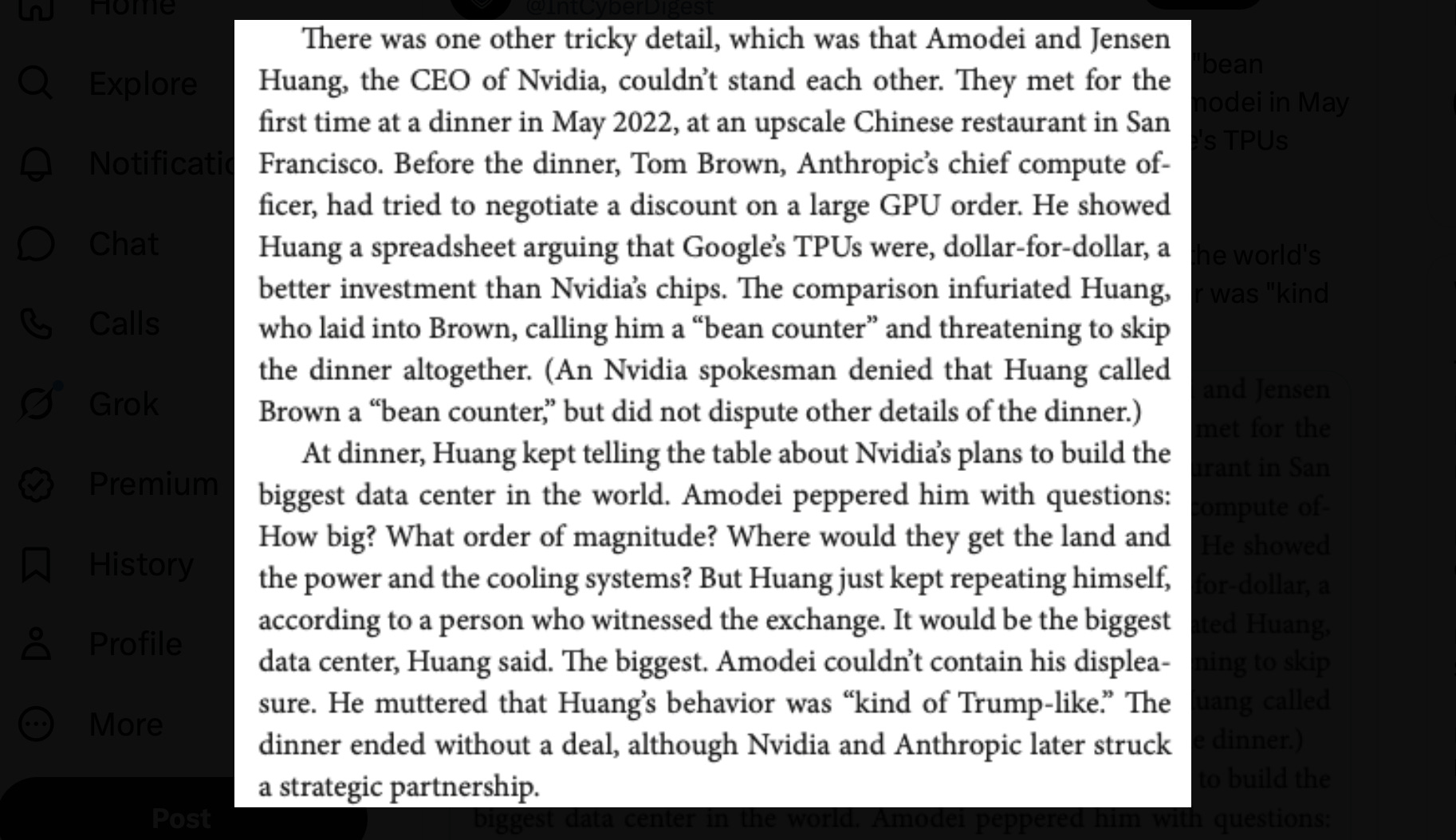
Anthropic faces two interconnected pressures on profit margins.
Open-weight and open-source models
Compute
Nvidia GPUs, CPUs, DPUs, LPUs, chip “plumbing” (interconnects and networking) and chip software
Nvidia is not connected to silicon fabrication (TSMC) or memory chips (SK Hynix, Micron, and Samsung)
Nvidia develops the Nemotron open-weight models. Nvidia also agreed to acquire the open-weight and open-source AI platform Hugging Face for $12.93 billion. In fact, Jensen Huang’s first post on X was in support of American open-weight models.
Many of the most popular open-weight models come from China-based labs. These open-weight models reduce margins of Anthropic’s mid tier models, particularly those below Fable.
Now Jensen is gone. It’s unclear if the new CEO will support open-weight AI models. This all benefits Anthropic.
Reduced support for nascent open-weight models will in turn lead to reduced demand for Nvidia’s products. This increases Anthropic’s (and OpenAI’s) capacity to negotiate better terms with the most powerful compute counterparty.
Huang’s exit could improve Anthropic’s margins through reduced competition and lower compute costs.
The State Department and Public Policy Edge
Open Philanthropy has been playing the long game in public policy better than anyone else. Consider this article from 2023.
In April, the same month Open Philanthropy granted RAND more than $5 million to research existential AI risk, Jeff Alstott, a well-known effective altruist and top information scientist at RAND, sketched out a plan to convince Congress to pass licensing requirements that would “constrain the proliferation” of advanced AI systems.
Technology How a billionaire-backed network of AI advisers took over Washington, Politico, October 2023
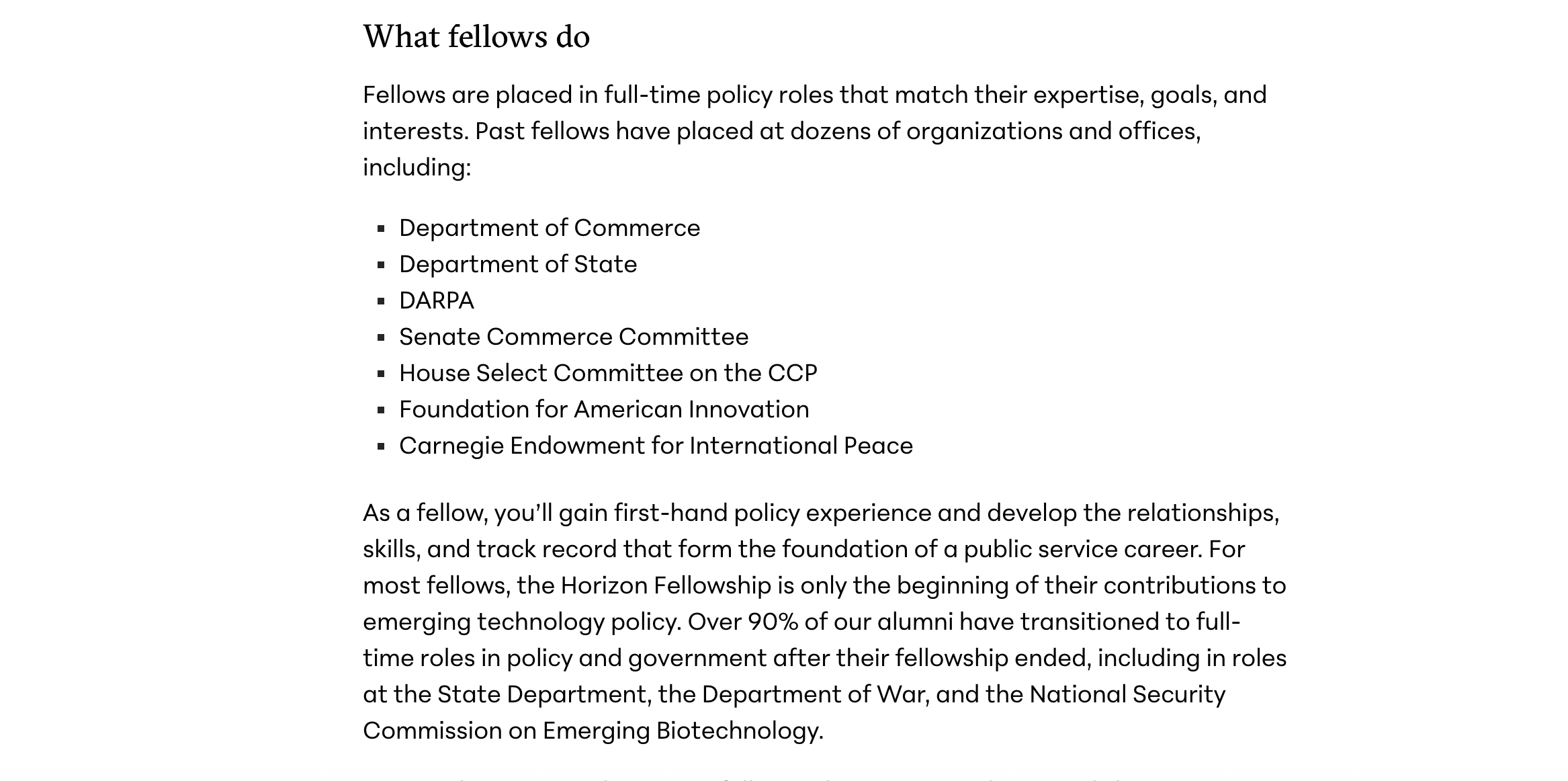
The Horizon Institute received $11 million and $3 million respectively from Good Ventures and Coefficient Giving (formerly Open Philanthropy). Both Good Ventures and Coefficient Giving were created and funded by Tuna and Moskovitz.
Articles about Jensen Huang’s affairs cited anonymous sources in the State Department. What are the odds these sources are Open Philanthropy recipients? I’ll take the over on this one.
As I wrote in Jacobin last May, President Joe Biden’s historic October 2022 semiconductor export bans gave every indication of being carefully directed by the Center for Security and Emerging Technology (CSET), an EA-aligned, Open Philanthropy–funded think tank based at Georgetown University. Senior White House figures ideally situated to dictate the contents of the controls had, in their capacity as CSET members and alumni, spoken and written extensively about their desire to use export regulation to hamper China’s relative progress on AI.
…
The close resemblance here of CSET’s suggestions for eventual White House policy should come as no surprise. Listed as one of the coauthors of the aforementioned policy papers was CSET’s “Commerce Department fellow” Emily Weinstein, who became a senior advisor at the BIS by the time the policies would have been drafted. She is joined in the Commerce Department by fellow CSET alumni Will Hunt, senior advisor at the Office of Export Administration, and Saif Khan, now senior advisor to the secretary on critical and emerging technologies.
Effective Altruists Are Stoking Tensions With China, Jacobin, February 2024
CSET was funded with a $55 million grant from Open Philanthropy in 2019 and received a second grant for $42 million in 2021.
CSET and RAND increasingly shape public policy on AI. Meanwhile, Horizon Fellows are spread throughout the Department of Commerce, the Department of State, DARPA and the House committee on the CCP.
This is AI soft power via public policy.
The AI Journalism Edge
The company privately complained to NBC News that the author of the story had been paid by the Tarbell Center for AI Journalism, as part of a fellowship program that embeds journalists within news organizations for several months to write stories about artificial intelligence and its growing impact.
OpenAI’s representatives pointed out that Tarbell, which has also supported reporting at Bloomberg, Time, The Verge, and The Los Angeles Times, is funded in part by one of the groups mentioned in the story, the Future of Life Institute, which is dedicated to warning about AI risks. The news organization quietly appended a disclosure to the piece noting the connection.
The Tarbell Center for AI Journalism receives funding from EA supporters, and its fellows are often EA-aligned writers.
2026 Tarbell Fellow Placements: Los Angeles Times, Defense One, Scientific American, Newcomer, Science, Understanding AI, MIT Technology Review, Lawfare, The Dispatch, The Information, NPR, TechCrunch, South China Morning Post, The Seattle Times, Rest of World, CNBC, The San Francisco Standard, CBS News, USA TODAY, Fortune, The Bureau of Investigative Journalism, The Verge, Platformer
Past Tarbell Fellow Placements: Bloomberg, ChinaTalk, Coda, Euractiv, NBC News, The Guardian, TIME, Transformer
This is soft power via journalism.
The Government Edge
Richard Blumenthal (D-CT) leads the Senate Judiciary Subcommittee on Privacy, Technology, and the Law. He holds jurisdiction over legal and regulatory issues regarding emerging technology, online privacy, civil rights, and AI governance. Blumenthal is a leading advocate for reducing semiconductor sales to Asia and increasing mandatory artificial intelligence oversight.
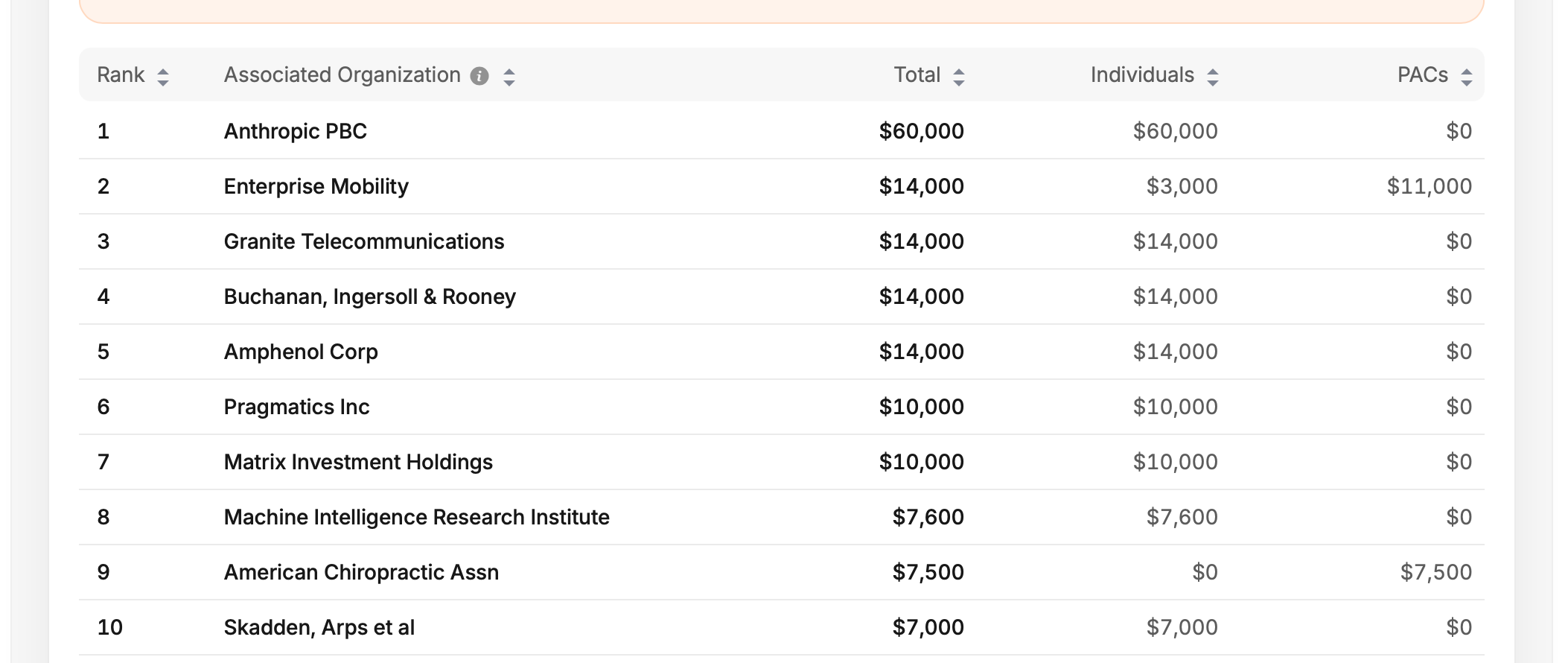
Anthropic employees are among Blumenthal’s largest fundraising sources of campaign contributions. Blumenthal has received $60,000 from Anthropic employees according to OpenSecrets. The Machine Intelligence Research Institute was founded by Eliezer Yudkowsky, an EA figurehead, as the Singularity Institute for Artificial Intelligence.
Sarthak Agrawal was placed as a Horizon Institute fellow in the Office of Senator Richard Blumenthal (D-CT) during the 2023–2024 term.
This is one U.S. senator.
Conclusion: Buy and keep Anthropic long-term.
The recent Blue Wave in Congress and the Senate benefits Anthropic the most out of all AI companies. Anthropic’s influence likely grows in 2028 with a new Democratic president.
I suspect the EA alliance could have played a role in Jensen Huang’s ouster, which removed the de facto figurehead of open-weight AI models. If that suspicion is correct, the alliance could use the same influence to strengthen Anthropic’s PR, adoption and ultimately profitability in the coming years.
Anthropic should be a part of anyone’s portfolio. It’s a good market-neutral AI trade to balance a portfolio with SpaceX, which benefits more from GOP influence.
For an emerging technology portfolio, I think equal weighting of Anthropic and SpaceX makes a lot of sense for a politically market-neutral position. Government contracts and media support are likely to swing to one company or the other.