

Nvidia’s board is contemplating firing Jensen Huang because of his paramours.
But is this good for Nvidia shareholders? The data says no.
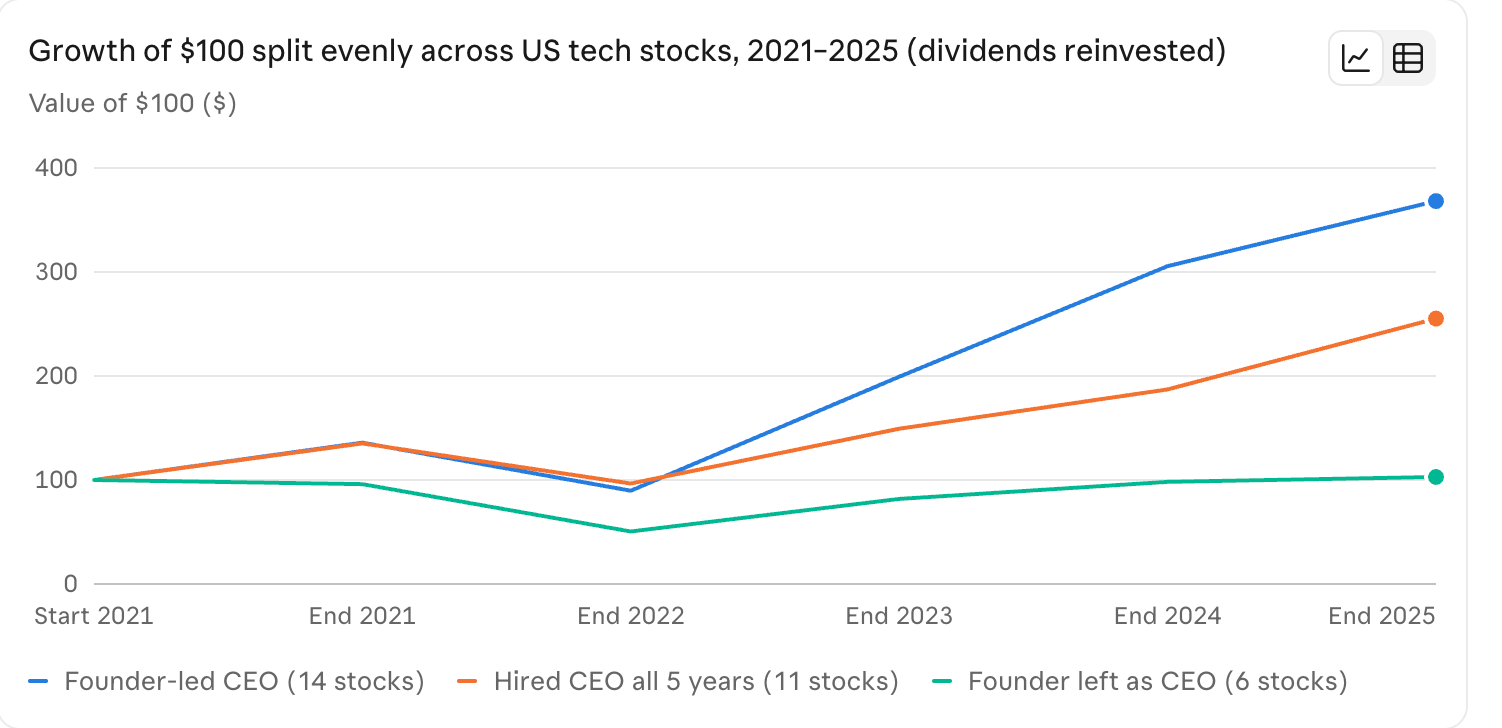
I compared the stock performance of three cohorts of tech companies: ones led by founder CEOs, hired CEOs, and successor CEOs who replaced founders.
Founder-led tech companies outperform hired CEOs and successor CEOs.
Jensen manages a flat team and has 60 direct reports. A new CEO would likely add bureaucracy layers which would slow down Nvidia’s current pace and adaptability.
Jensen Huang also has a decades-long friendship with TSMC founder Morris Chang (which makes 90% of the world’s high end chips). In fact, Morris Chang offered Jensen Huang the CEO position of TSMC in 2013. At the time, TSMC was was worth ten times as much as Nvidia.
Companies connected to Alice Huang’s supposedly facilitated $7.5 billion of chips. This number is less than 1.3% of Nvidia’s revenue since 2023. There is excess demand for Nvidia’s chips. This figure is trivial.
If the chips representing 1.3% of Nvidia’s sales are a security threat, then America should prioritize defending Taiwan by any means necessary.
90% of fabrication of high end chips used for AI are made in Taiwan. If TSMC fabrication plants were seized or destroyed, America’s AI lead likely disappears.
Either the 1.3% figure is trivial OR defending Taiwan and their fabrication plants should be America’s number one geopolitical priority. You can’t say the first is important and the second statement is not true.
If you believe the chips are important, you should retain the man that Morris Chang trusted enough to be CEO of his company in 2013.
The congressional movement to question Jensen Huang is a charade. This coup d’état does not serve the goal of increasing shareholder value.
Founder-led CEO Prior Research
Two passages from previous research into founder-CEOs are relevant. Founder CEOs consider their firm their life’s achievement. You can’t hire anyone that has this attribute except the founder.
Founder-CEOs differ from successor-CEOs in several aspects. Founder CEOs are less likely to be removed from office than other CEOs. Founder-CEOs often consider their firm as their life’s achievement. This intrinsic motivation and long-term approach encourages founder-CEOs to pursue the optimal shareholder-value maximizing strategy instead of concentrating on short-term actions or “enjoying the quiet life.” Founder-CEOs may have more organization-specific skills. Thanks to their equity stake and their entrepreneur status, founder-CEOs are likely to have more influence and decision-making power.
- Journal of Financial and Quantitative Analysis, by Rüdiger Fahlenbrach
They make more money.
An equal-weighted (value-weighted) investment strategy that invested in founder-CEO firms during 1993–2002 would have earned an abnormal return of 8.3% (10.7%) annually in excess of what could have been achieved by a passive investment in the four factors described in Fama and French (1993) and Carhart (1997).
- Journal of Financial and Quantitative Analysis, by Rüdiger Fahlenbrach
The companies from the first graph are listed below for interested parties.
Founder CEO:
Nvidia, Meta, Salesforce, Fortinet, Palantir, Crowdstrike, Dell, Datadog, The Trade Desk, Super Micro Computer, Monolithic Power Systems, Akamai, Verisign, Spotify.
Hired CEO:
Apple, Microsoft, Alphabet, Broadcom, AMD, Cisco, Intel, Adobe, Qualcomm, IBM, Texas Instruments
Founder left to new CEO:
Amazon, Pinterest, Netflix, Lyft, Synopsys, Twilio